
Earlier this year, Uber reportedly burned through its annual AI budget in the first four months. Microsoft, according to Axios, canceled most of its internal Claude Code licenses in May. That’s the backdrop for what Anthropic launched on October 28, 2026: three tools for Claude Enterprise customers, led by Claude smart reports, that show managers what their teams actually do with Claude and what it costs.
Here’s why this matters if you’ve never bought AI for a company. Businesses pay for AI partly by the seat and partly by usage, measured in tokens, the small chunks of text an AI model reads and writes. Heavy users can run up big bills fast, and finance teams have started asking a blunt question: what are we getting for this? Here’s what Anthropic built to answer that, what the reports can and can’t tell you, and why they’re also good business for Anthropic.
Why AI Bills Became a Boardroom Problem in 2026
AI costs didn’t just rise this year. They rose faster than most companies planned.
Engineering analytics company Jellyfish tracks AI use across more than 1,300 companies and 294,000 engineers. In its October AI engineering report, the median company’s AI spend per engineer grew 3.8 times between the first and third quarters of 2026, while headcount stayed at 98% of first-quarter levels. Its heaviest users now spend about $1,121 a month each. By our math, that’s about $13,450 a year per engineer, before salaries.
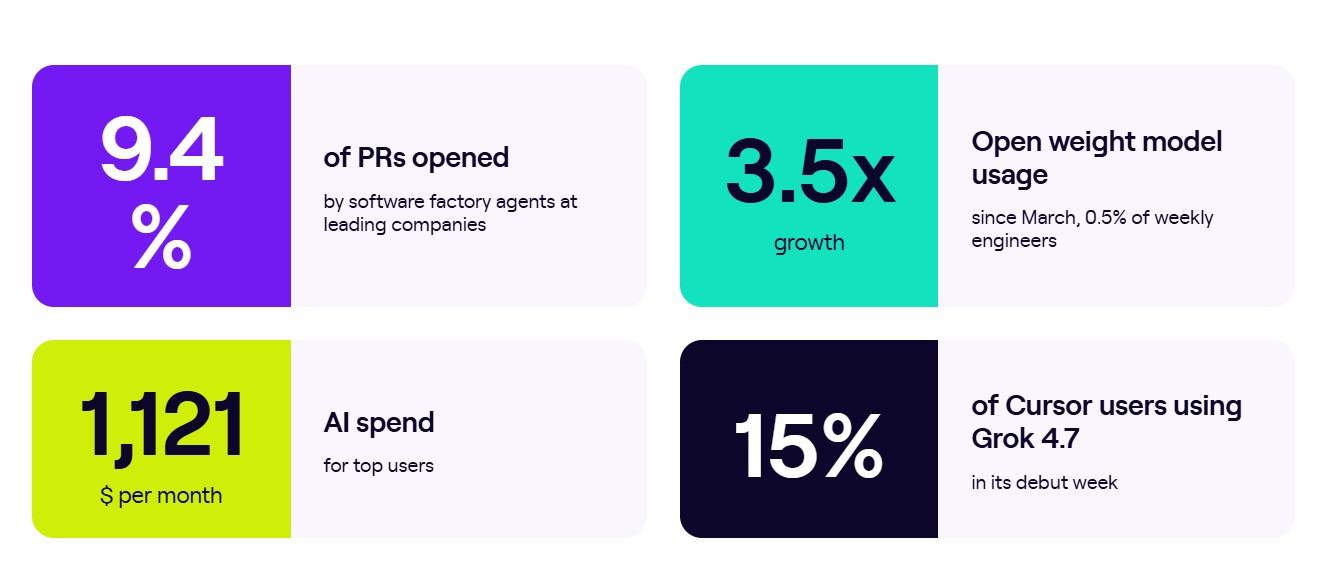
Jellyfish also found that Claude Code and other tools built on Anthropic’s models were behind nearly a third of the code changes submitted for review in its data. That makes Anthropic the biggest winner of this spending boom, and the most exposed if customers decide the bill is too high.
There’s good news in the same data. Jellyfish says the median cost of producing a merged pull request, a finished code change accepted into a project, fell from $1,202 to $820 over the past year, a drop of about 32% by our math. AI’s direct share of that cost is about $18 of the $799 average, or roughly 2%. So the spending is real, but it’s still small next to what companies pay people.
What Anthropic Launched
All three tools are generally available now for Claude Enterprise, Anthropic’s top business plan.
| Tool | What it does | Who uses it |
| Smart reports | Analyzes a sample of a team’s Claude sessions and groups them into workstreams, with spend, deliverables and friction points for each | Admins, plus team leads that owners approve |
| In-app surveys | Short questions that pop up inside Claude, such as what would break if the team lost access tomorrow | Admins create them; employees answer |
| Pooled group budgets | One shared monthly budget per team, with individual limits as a backstop | Admins with billing permissions |
How Claude Smart Reports Work
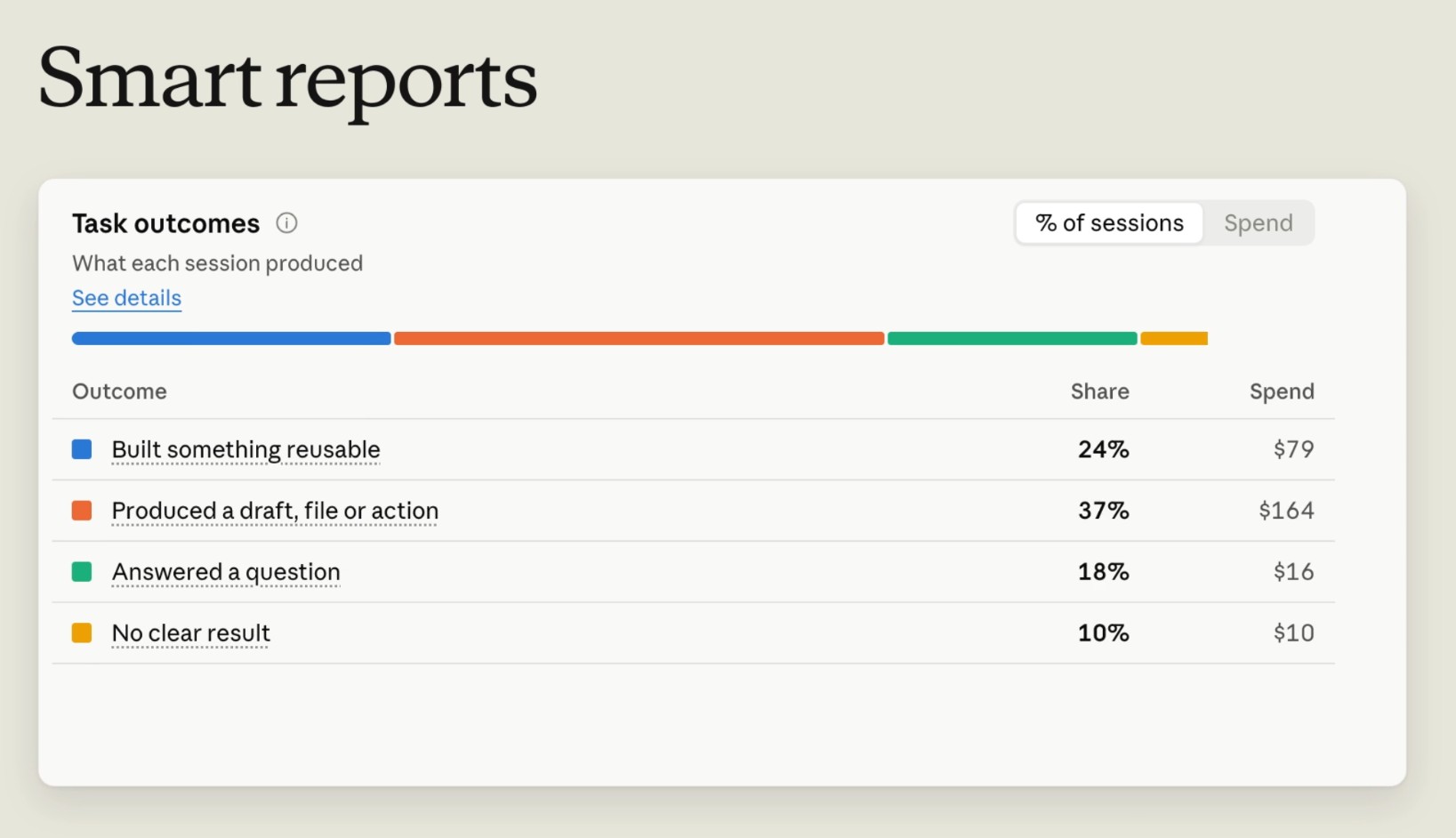
A manager picks a team, a date range, and the Claude products to include. Claude then reviews a sample of that team’s transcripts, the records of their conversations and tasks, and sorts the work into workstreams. For each workstream, the report shows spend, what got produced and where things went wrong, such as a missing connector (a link to another app) or a failed tool call.
Each report ends with one list of recommendations. These include repetitive workflows worth turning into skills, which are reusable instruction sets Claude can follow, and rules to add to a company’s code repository. Managers can also ask custom questions about usage and cost, and save them as templates for future reports.
Anthropic says some customers base each report on tens of thousands of sessions. John Jannone, an AI enablement lead at DoorDash, said in Anthropic’s announcement that smart reports “still surfaced things I didn’t know.”
How Pooled Budgets Work
Pooled group budgets stop heavy users from hitting a personal limit mid-month while a teammate’s allowance sits unused, by putting one shared monthly budget on the whole team. Individual limits still apply as a guardrail, and every request counts against both. Whichever runs out first stops the user.
Anthropic suggests a budget based on the group’s recent usage, and billing admins get email alerts at 50%, 75%, 95% and 100% of the budget. Employees who hit a limit can request more from inside Claude.
What the Reports Measure, and What They Can’t
Smart reports measure activity and cost: what people did, how much it cost and where they got stuck. Surveys add what employees say Claude saved them. Neither one measures business results, such as revenue, profit, customer satisfaction or fewer bugs in production. A report can show that a team produced 400 documents with Claude. It can’t show whether those documents were worth producing.
There are three other limits worth knowing:
- It’s a sample. Reports analyze a sample of transcripts, not every session, so rare but expensive work could be missed.
- Surveys are self-reported. People who like a tool tend to overestimate the time it saves, and those who dislike it may not answer at all.
- Claude is grading Claude. The analysis runs on Anthropic’s own model, reviewing work done with Anthropic’s own product. That doesn’t make it wrong, but it isn’t an independent audit.
In our analysis, smart reports are best read as a receipt with notes, not a return-on-investment calculation. They tell you where the money went and how to use it better. Proving that it paid off still takes your own numbers.
Who the Reports Really Serve
Anthropic is the company that sells the tokens, and it’s now selling the tool that explains the token bill. That’s worth thinking about, especially with the timing.
Anthropic filed to go public on October 26, two days before this launch. Its filing reported about 900% net revenue retention at the end of the third quarter. Net revenue retention compares what a group of existing customers spends now with what they spent a year earlier. At 900%, a customer that paid $100,000 a year ago pays about $900,000 today. The filing also lists about 250 customers spending $10 million or more a year, and it warns that a big drop in spending by its largest customers could hurt the business.
So the reports serve two goals at once. They help customers cut waste. They also help an internal “AI champion” defend the budget to a skeptical finance team, which protects Anthropic’s growth. One feature makes that dual role clear: if a spend limit is holding someone back, billing admins can raise it straight from the report.
None of this is sinister, but whoever reads a smart report should remember who designed it, just as Anthropic’s IPO disclosures raised questions about risk and control.
Anthropic vs OpenAI: The Race to Explain the AI Bill
Both big AI labs have spent the second half of 2026 building tools for finance teams.
| Date | Company | What launched |
| June 18, 2026 | OpenAI | ChatGPT Enterprise usage analytics and spend controls, with workspace, group and individual limits |
| July 2, 2026 | Anthropic | Claude Enterprise spend alerts, default-model settings, cost dashboards by team, and Claude Code cost-per-commit estimates |
| Oct. 28, 2026 | Anthropic | Smart reports, in-app surveys and pooled group budgets |
The difference is the question each answers. OpenAI’s June tools mostly answer “who is spending what?” Anthropic’s new reports try to answer “what did the spending produce, and how do we copy what worked?” That’s a more ambitious pitch, and a harder one to verify.
What About Employee Privacy?
If your employer uses Claude Enterprise, you might wonder whether your manager can now read your chats. Here’s what Anthropic says:
- Reports work from a sample of transcripts grouped into team-level workstreams.
- Smart reports “aren’t for evaluating individual performance or making employment decisions,” according to Anthropic.
- Survey answers count as the customer’s data, and Anthropic says it accesses them only to run the service.
That’s a policy promise, not a technical block. In our view, employees should treat anything they type into a work AI tool the way they’d treat a work email: visible to the company in principle.
Five Questions to Ask Before You Trust the Report
- Which outcome would we expect to change if this workstream is working?
- How large is the transcript sample behind each finding?
- Which recommendations save money, and which ones increase usage?
- How do survey answers compare with what the report actually shows?
- What would we stop paying for if the numbers looked bad?
Smart reports make AI spending easier to see, and that’s a real step forward for companies flying blind. Just remember that a clearer receipt isn’t the same as a better return.
FAQs
Can small companies get Claude for free?
Sometimes. Anthropic offers credits to early startups through partner programs, and the value can cover months of testing.
Can I use Claude inside Google’s Gemini?
In some cases, yes. Google has added Anthropic’s Claude as an option inside Gemini for businesses, so one subscription can reach both.
How do AI companies check that their agents behave?
They use monitoring systems that watch what agents do, and some invite outside testers. Testers found six gaps in OpenAI’s AI agent monitoring system in three weeks, which shows how hard oversight is.
How many people use ChatGPT at work?
ChatGPT is still the most widely used AI chatbot, and business use is growing fast.
Why are banks wary of AI agents?
Agents that log in with your password can move money in ways banks can’t easily monitor. That’s why JPMorgan shut the door on AI agents like Muse accessing customer accounts at Chase.
The post Anthropic Now Shows Companies What Their Claude Bill Buys appeared first on Memeburn.