
If you own a share of Apple through a brokerage app, that share almost certainly sits at a company you’ve never heard of: the Depository Trust Company (DTC), part of the Depository Trust & Clearing Corporation (DTCC). On October 28, 2026, it switched on a DTCC tokenization service that can turn the stocks, funds and government bonds it holds into blockchain tokens. Headlines put the number at $30 trillion.
Here’s the context in one line. DTCC is the back office of the US stock market, holding more than $114 trillion in securities and settling almost every trade, so when it adopts blockchain, it’s the system itself changing rather than a crypto startup knocking on Wall Street’s door. Here’s what launched, what the $30 trillion actually measures, how a DTCC token differs from the “tokenized stocks” you may have seen on crypto apps, and what it means for your own investments.

Binance Referral Code
$100 Sign-Up Bonus
20% Lifetime Discount on Trading Fees
Code Valid: November 2026
Claim Reward
What the DTCC Tokenization Service Does
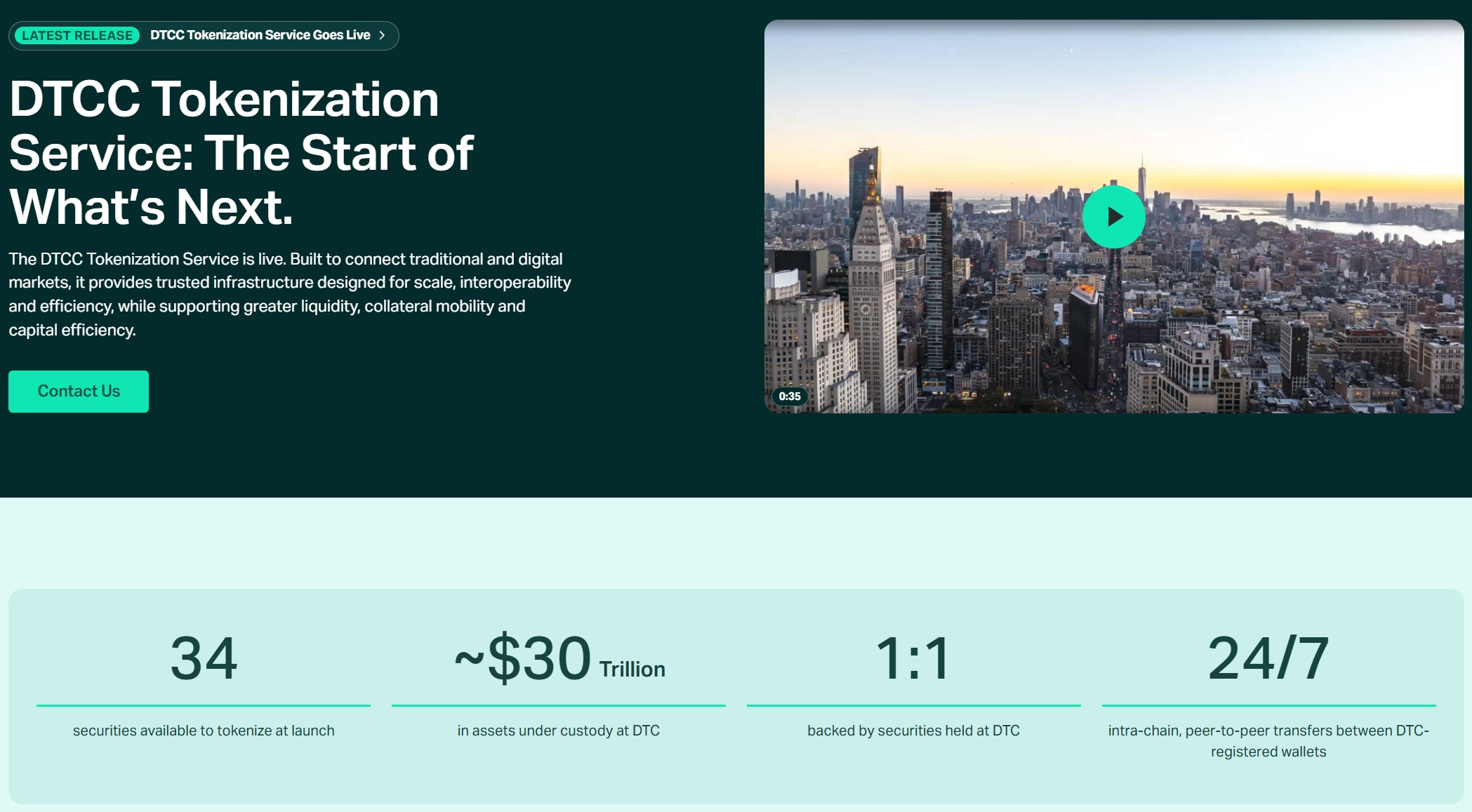
The DTCC Tokenization Service lets approved firms convert securities held at DTC into digital tokens and back again. The basics, as of launch day:
- What’s eligible: 34 securities at launch, drawn from stocks in the Russell 1000 index (the 1,000 largest US companies), ETFs that track major indexes, and US Treasury bills, notes and bonds.
- Where the tokens live: the Canton Network, a blockchain built for financial institutions, and DTCC’s own private network built on Besu, an Ethereum-based software.
- Who can use it: 20 DTC participants that have signed agreements. More will be added on a rolling basis.
- How fast: DTCC says tokens can be created “within minutes,” with a reported target of 15 minutes or less.
- What the token is: a tokenized entitlement, a digital record of the same ownership rights you’d have in the regular system, with the same identifying code, called a CUSIP.
“Today marks the culmination of years of work to bring tokenized securities into a regulated framework,” DTCC president and CEO Frank La Salla said in the company’s launch announcement.
What the “$30 Trillion” Actually Measures
The $30 trillion isn’t money that moved onto a blockchain on Wednesday. According to a DTCC spokesperson, it’s the total market value of the 34 securities that are eligible for tokenization. DTCC hasn’t disclosed how much has actually been converted, or any trading volume.
Here’s how we put the number in proportion:
| Figure | Value | What it tells you |
| Market value of the 34 eligible securities | About $30 trillion | What could be tokenized, not what has been |
| Average per eligible security (our math) | About $882 billion | The list is mega-cap stocks, big ETFs, and Treasuries |
| Total assets in DTC custody | More than $114 trillion | The whole system DTCC runs |
| Eligible share of DTC custody (our math) | About 26% | A quarter of the system is now able to go on-chain |
| Citi’s forecast for the whole tokenized securities market by 2030 | $5.5 trillion | How big analysts expect real usage to get |
By our math, the eligible pool at launch is already more than five times Citi’s forecast for the entire tokenized securities market four years from now. That gap is the clearest sign that eligibility and adoption are very different things. The pipes are big, but the water is only starting to flow.
How a DTCC Token Works
Think of a DTCC token as a new wrapper around the same share, not a new share.
- A participating firm, say a broker, holds Treasury bonds at DTC the traditional way.
- It asks DTC to convert some of them into tokens. DTC still keeps the official ownership records.
- The tokens go to a registered digital wallet the firm controls, or one it has registered for a client.
- The firm can move those tokens to other registered wallets, for example, as collateral, an asset pledged to back a loan or trade.
- When it’s done, the firm can convert the tokens back into the regular form.
Two details matter for what this can and can’t do today, and both come from DTCC’s design as described by blockchain-industry analysts at Ledger Insights:
- 24/7, but only on one chain. Tokens can move between registered wallets around the clock, but only within the same blockchain. Moving from Canton to Besu goes through DTC’s conversion service, which runs from 2 a.m. to 6 p.m. Eastern on business days.
- Faster settlement. Today, US stock trades settle on T+1, meaning one business day after the trade. Token transfers settle when the position moves between wallets.
By our math, the conversion window covers 16 hours a day, about 2.5 times the 6.5-hour core trading session on the New York Stock Exchange. It’s a meaningful stretch of Wall Street’s working day, but not yet a true round-the-clock market.
DTCC Tokens vs. the Other “Tokenized Stocks”
“Tokenized stocks” now means several different things, and they carry different risks. Here’s how we’d sort them:
| DTCC tokenized entitlement | OKXICE tokenized shares (planned) | Wrapped or synthetic stock tokens | JPM Coin | |
| What it represents | A real security held at DTC | Real shares, traded on a 24/7 crypto venue | Shares held by a third party, or just a price tracker | US dollars held at JPMorgan |
| Who issues it | DTC | Venue run by OKX and ICE | A crypto or fintech firm | JPMorgan |
| Who can hold it | Approved firms’ registered wallets | Verified traders | Varies, often anyone on the platform | Approved institutional clients |
| Can the company object? | Not part of DTCC’s model | Yes, and several have | Usually not | Not applicable |
| Main use today | Collateral and settlement between firms | Weekend and overnight trading | Retail trading outside US hours | Payments between firms |
The OKXICE row matters because big companies have already pushed back. Microsoft, Alphabet and Goldman Sachs were among the firms objecting to OKXICE trading tokens of their stock around the clock. DTCC’s version is closer to plumbing than a trading venue, which is one reason it has drawn far less resistance.
There’s also a likely bridge between the two worlds. Crypto-friendly broker Alpaca is a launch participant, and tokenization firm Ondo is a collaborator, which suggests some firms may build their own retail products on top of DTCC’s tokens later. That’s our reading, not something DTCC has announced.
Who’s In, and Who’s Missing
The 20 launch participants are a who’s who of US finance:
- Big banks and custodians: JPMorgan, Citi, Bank of America, Barclays, BNP Paribas, UBS, Morgan Stanley, State Street, Brown Brothers Harriman
- Brokers and clearing firms: Fidelity Investments, Edward Jones, Apex Clearing, DriveWealth, Clear Street, Interchange Clearing, Marex, Mirae Asset Securities (USA)
- Trading and crypto-friendly firms: Citadel Securities, Alpaca, Velocity Capital
Two absences stand out to us: BNY, the world’s largest custodian, and Goldman Sachs, which took part in DTCC’s July live trials. Neither has explained its absence, and both could still join. Another 17 companies, including BitGo, Fireblocks, Broadridge, Tradeweb and Ondo, are named as technology collaborators rather than users.
How We Got Here
| Date | Milestone |
| Dec. 11, 2025 | The SEC’s staff issues a no-action letter letting DTC tokenize a defined set of securities |
| May 2026 | DTCC sets a July pilot and an October launch, and outlines plans to add Stellar |
| July 15, 2026 | More than 30 firms complete limited live trades with DTC tokens |
| Oct. 28, 2026 | The tokenization service goes live with 20 participants and 34 securities |
| Early 2027 | DTCC’s Besu-based collateral network is due |
| 2027 | Stellar and Circle’s Arc blockchain to be added, plus more securities and on-chain cash settlement |
A no-action letter is the SEC staff’s written promise not to recommend enforcement if a firm follows the conditions it lays out. By our count, DTCC went from that letter to a live service in 321 days, which is fast for the most conservative corner of finance.
What to Watch Next
- First usage numbers. DTCC hasn’t published conversion or transfer volumes. Those will show whether the $30 trillion pool sees real use.
- New participants, especially BNY and Goldman Sachs.
- Cash on-chain. DTCC says it’s exploring stablecoins and tokenized bank deposits to pay for tokenized securities. Without a digital cash leg, much of the settlement still runs through traditional systems.
- More eligible securities. The roadmap adds more assets in 2027.

Binance Wallet Referral Code
100 USDT Sign-Up Bonus
20% Lifetime Discount on Trading Fees
Code Valid: November 2026
Claim Reward
DTCC didn’t put $30 trillion on a blockchain this week. It did something that may matter more in the long run: it made the blockchain an officially supported route through the core of the US market. Whether firms take that route is the story of 2027.
FAQs
What is the SEC’s crypto custody proposal?
It’s a plan that would let registered financial advisers hold crypto for clients the way they hold stocks and bonds. The SEC crypto custody proposal explains what would change and who it affects.
Can a company issue shares directly on a blockchain?
Yes, in some countries. Instead of a broker holding the share, the token is the share itself. A Swiss company issued tokenized company shares on Cardano this way, though the setup comes with trade-offs.
Are small US banks building blockchain networks too?
Yes. In August, 39 state banking associations representing about 4,000 banks agreed to build a shared blockchain for community and regional banks for tokenized deposits and payments.
Why are blockchain fees so low on some networks now?
Many newer networks bundle transactions or run on cheaper infrastructure. Robinhood’s own network saw Robinhood Chain fees drop 97%, which could make small tokenized trades cheaper over time.
What happened to the US crypto market structure bill?
The Clarity Act, which aimed to set clear rules for crypto markets, failed in the Senate in 2026. That leaves much of tokenization running on SEC staff relief and exemptions for now.
The post Wall Street’s Plumbing Just Went On-Chain With $30 Trillion Holdings appeared first on Memeburn.