
If you only glanced at the S&P 500 on November 24, 2026, you’d have seen a down day, with the index closing 0.5% lower as NVIDIA fell 5.9% and other artificial intelligence (AI) stocks gave back part of Monday’s gains. When I looked at what happened underneath, though, the picture flipped: nearly 70% of the stocks in the index actually rose, and the Dow Jones Industrial Average gained 0.85%. So how can most stocks go up while the index goes down? In this piece I’ll walk through the breadth numbers, the math behind NVIDIA’s outsized pull, what the equal-weight version of the index showed, and where the money went instead, because the gap says a lot about how much the US market now leans on a handful of companies.
Nearly 350 S&P 500 Stocks Rose During the AI Selloff

Binance Referral Code
$100 Sign-Up Bonus
20% Lifetime Discount on Trading Fees
Code Valid: November 2026
Claim Reward
Only a day after NVIDIA surged 31.5% on Jensen Huang’s reinstatement as CEO, semiconductor and AI infrastructure stocks came under selling pressure again. According to Associated Press market coverage, NVIDIA fell 5.9%, CoreWeave dropped 11.8%, and Anthropic declined 6.5%, slipping below its initial public offering (IPO) price of $83. The rest of the market, however, had a much better day than those headlines suggested.
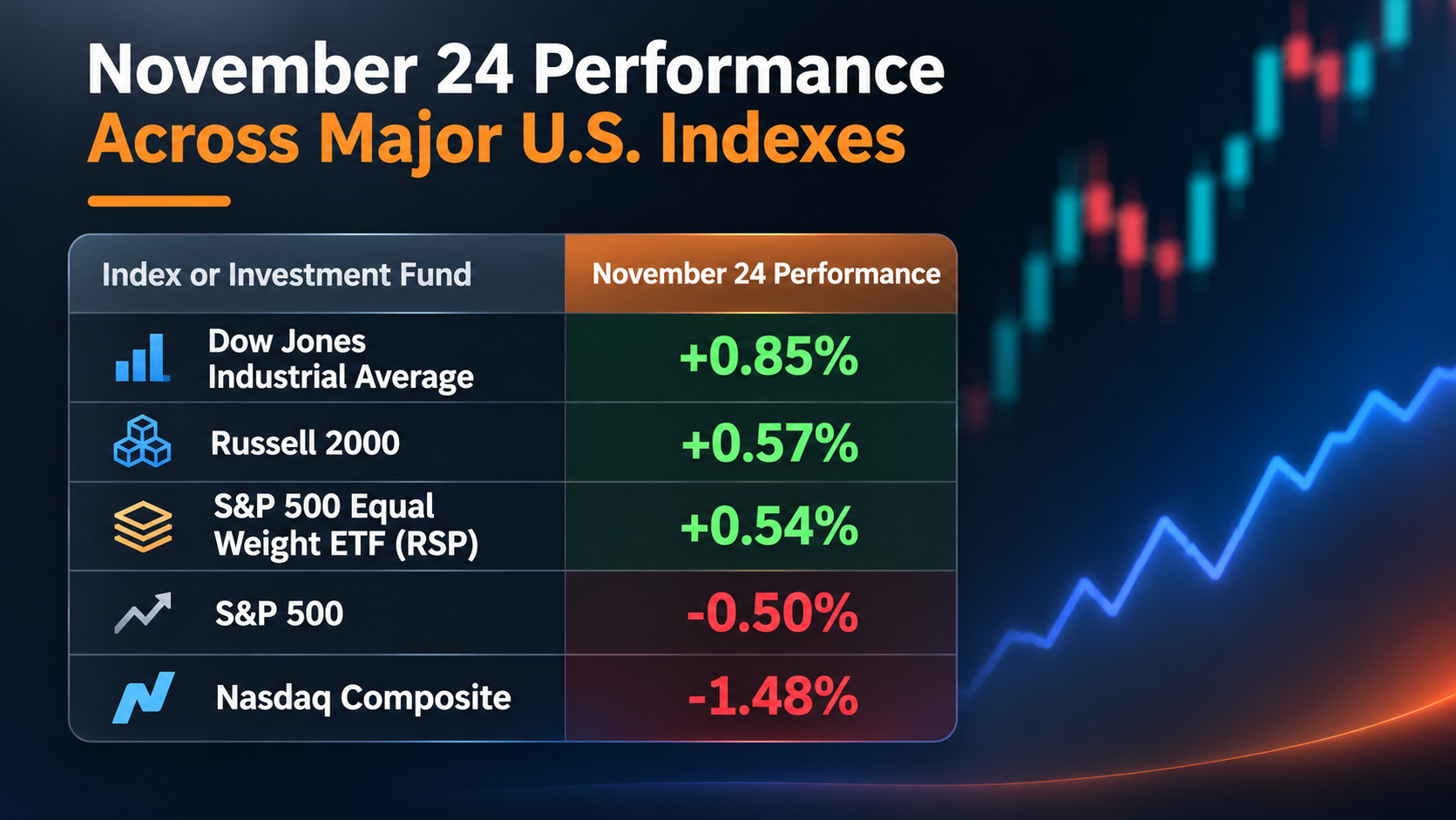
| Index or investment fund | November 24 performance |
| Dow Jones Industrial Average | +0.85% |
| Russell 2000 | +0.57% |
| S&P 500 Equal Weight ETF (RSP) | +0.54% |
| S&P 500 | -0.50% |
| Nasdaq Composite | -1.48% |
Market breadth data compiled by Quant500 showed that 348 of the 500 S&P 500 securities it tracks advanced, while 151 declined and one was unchanged, and the median stock gained 0.98%. Tech companies have pulled in most of the market’s attention throughout 2026, yet Tuesday’s session showed that their performance can drift a long way from what the wider economy is doing.
Why NVIDIA Can Outweigh Hundreds of Other Stocks

Tradingview Promo Code
Get a $15 Discount
Unlimited advanced charts, indicators, and alerts. Step up your trading.
Code Valid: November 2026
Claim Reward
The answer to the puzzle sits in how the index is built. The S&P 500 is weighted by market capitalization, the total value of a company’s shares, so larger companies move the index far more than smaller ones, which is why the share of stocks rising on a given day can tell a very different story from the index itself.
Here’s a simple way to see it. Imagine a company that makes up 6% of the S&P 500: if its stock falls 5.9%, it knocks roughly 0.35 percentage points off the index on its own, assuming nothing else changes. A company with a 0.2% weighting that drops by the same 5.9% would subtract only about 0.012 percentage points, so the bigger company has 30 times the influence for an identical percentage loss.
That concentration is also why Jensen Huang’s return mattered well beyond NVIDIA’s own shareholders. NVIDIA sits at the center of the AI supply chain, so its growth prospects are tied to chipmakers, memory suppliers, cloud providers and data center operators, a web of dependencies I looked at in our analysis of NVIDIA’s first earnings report without Jensen Huang. When investors rethink how much will be spent on AI infrastructure, several of these large companies tend to fall together, and that amplifies the hit to the major indices.
The Equal-Weight S&P 500 Tells a Different Story
If you want to measure how concentrated the market has become, one of the clearest tests is to compare the regular S&P 500 with its equal-weight counterpart. According to S&P Dow Jones Indices, the S&P 500 Equal Weight Index gives each company roughly 0.2% of the index at every quarterly rebalancing, which hands the smaller members far more say over its performance than they have in the standard index.
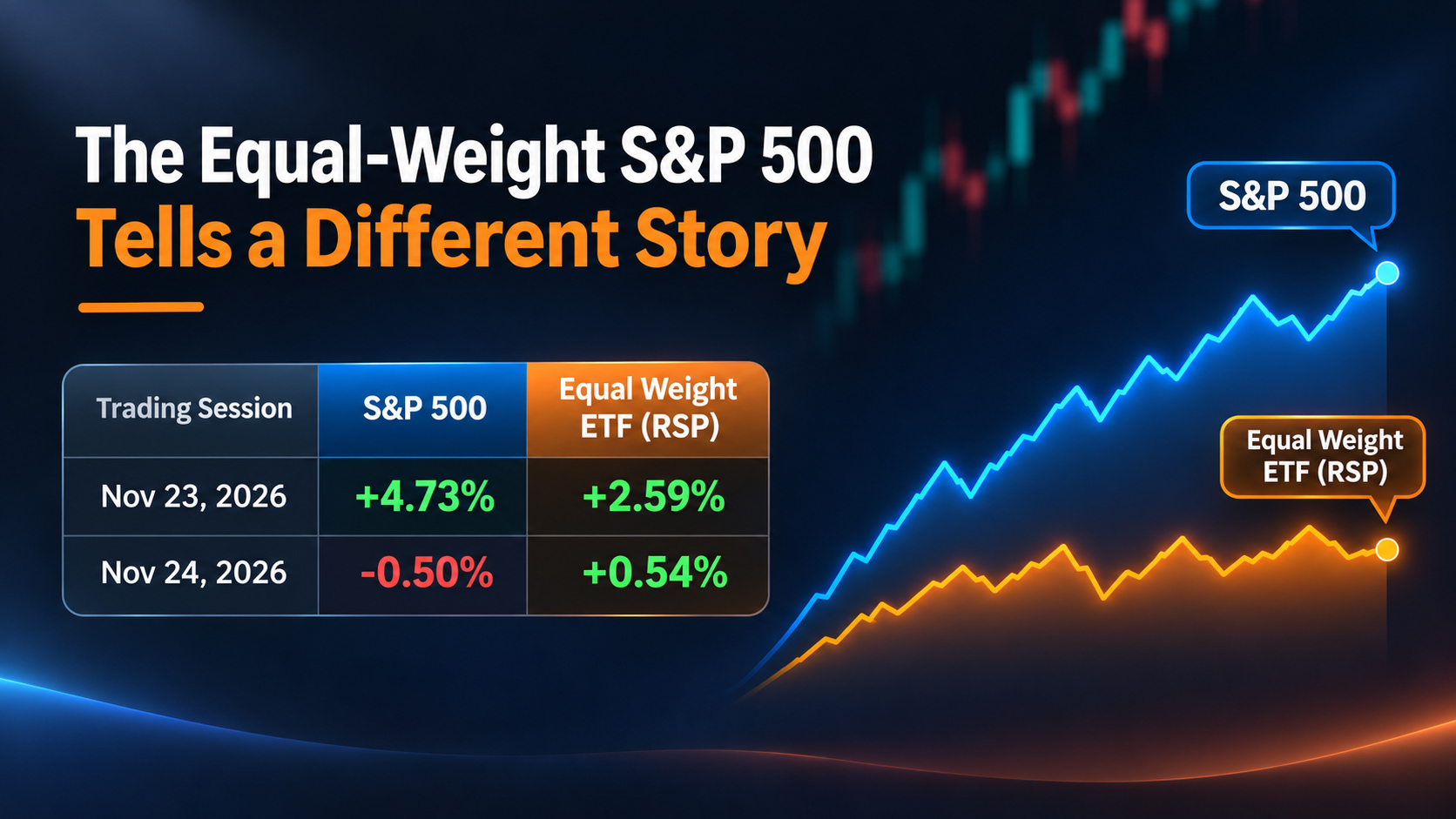
The Invesco S&P 500 Equal Weight ETF (RSP), an exchange-traded fund that tracks this alternative index, posted the following returns, according to historical market data.
| Trading session | S&P 500 | Equal Weight ETF (RSP) |
| November 23, 2026 | +4.73% | +2.59% |
| November 24, 2026 | -0.50% | +0.54% |
During Monday’s AI-driven rally, the regular S&P 500 beat RSP by 2.14 percentage points, while on Tuesday the relationship reversed and RSP came out ahead by about 1.04 percentage points. The same group of companies produced very different results depending only on how much weight each one carried. For you as an investor, that’s a reminder that owning hundreds of companies through an index fund doesn’t necessarily protect you from being concentrated in a single theme like AI.
Consumer Stocks Rallied While Chipmakers Sold Off
So where did the gains come from? While semiconductor companies struggled, several consumer and healthcare names posted big moves, with Dollar Tree rising 11.2%, Moderna gaining 7.2% and Nike advancing 5.9%. Elsewhere in the US market, Kohl’s jumped 19.5% after its quarterly results.
Those gains also lined up with a clear improvement in economic sentiment. The Conference Board’s November consumer confidence survey showed its headline index climbing from 91.9 in October to 103.3 in November, as consumers rated current business conditions and the job market more favorably and grew more optimistic about the months ahead. For companies whose earnings depend heavily on household spending, that kind of shift can matter more than any change in expectations for AI infrastructure investment, and it adds another layer to the AI stock selloff, since tech is weakening at the same time as conditions elsewhere are improving.
AI Market Concentration Could Create Valuation Gaps Elsewhere
I think the gap between the regular S&P 500 and its equal-weight version is the number worth watching over the next few months. Tuesday’s 1.04-percentage-point gap came on a day when nearly 70% of the tracked stocks rose, and if that pattern keeps repeating across several earnings seasons, it would suggest that market leadership is broadening beyond AI infrastructure companies.
The more interesting question for long-term investors is whether the companies getting less attention are also growing earnings faster than their share prices reflect. If a company’s earnings per share rise 20% while its stock price stays flat, for example, its price-to-earnings ratio falls by about 16.7%, and that kind of divergence can turn into a valuation opportunity if the earnings improvement holds up. (How I calculated it: a flat price divided by earnings 1.2 times higher leaves the ratio at 1/1.2, or about 83.3% of where it started.)
That said, one trading session can’t prove that money is permanently moving away from AI, and I’d want to see sustained shifts in relative valuations, fund flows and corporate earnings before calling it a rotation. As I argued in our look at the 2026 AI stock rally, whether AI companies can turn revenue growth into lasting profits remains one of the biggest questions for the next phase of this market.
FAQs
Why did the S&P 500 fall when most stocks rose?
The S&P 500 weights companies by market capitalization, so large declines in heavily weighted companies such as NVIDIA can outweigh gains across hundreds of smaller members of the index.
How many S&P 500 stocks rose on November 24, 2026?
Quant500 recorded 348 advancing stocks, 151 decliners and one unchanged security across its sample of 500 S&P 500 securities, which means 69.6% advanced.
Does the AI selloff indicate a broader market rotation?
The outperformance of equal-weight and small-cap benchmarks shows that gains extended well beyond technology stocks on November 24, 2026. Longer-term data on fund flows, valuations and earnings is needed to establish whether a sustained rotation away from AI is underway.
The post Nearly 70% of S&P 500 Stocks Rose, but NVIDIA and AI Stocks Dragged the Market Lower appeared first on Memeburn.