
$952 billion. That’s roughly how much stock market value Nvidia added on Monday, November 23, 2026, after its board reinstated Jensen Huang as CEO, 11 days after he resigned as CEO. It was the stock’s third-best day on record, and it pulled the whole market up with it.
Nvidia designs most of the chips that train and run today’s AI, and it’s one of the biggest holdings in index funds and retirement accounts. Last week, chip stocks had their worst week since 2001 on fears that the AI spending boom is running out of road. Huang’s return removed one source of that fear. Here’s what it fixed, and the five problems that were there before he left and are still there now.

Tradingview Promo Code
Get a $15 Discount
Unlimited advanced charts, indicators, and alerts. Step up your trading.
Code Valid: November 2026
Claim Reward
What Nvidia’s Board Actually Decided
According to Nvidia’s 8-K filing, a report companies must send to US regulators when something major happens, the board voted unanimously to bring Huang back as president, CEO, and director, effective immediately. It said it was satisfied with his candor after several meetings with him. It also said it got input from senior levels of the US government and is confident his return poses no national security risk.
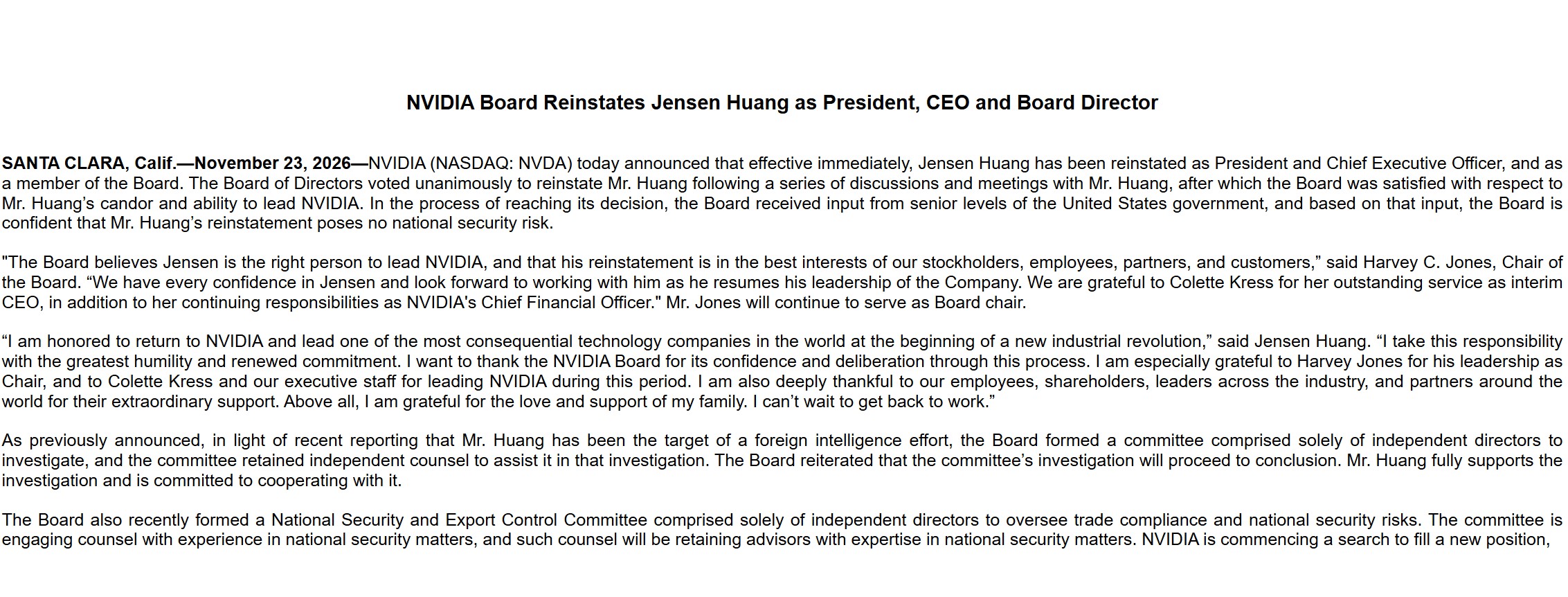
The filing also shows what stays in place:
- Colette Kress goes back to being chief financial officer full time, after serving as interim CEO.
- Harvey C. Jones stays as board chair. “The Board believes Jensen is the right person to lead NVIDIA,” he said.
- The board’s own investigation continues and will run to its conclusion, with Huang cooperating.
- A new Chief Compliance Officer will oversee compliance across the company and report to a board committee, not to Huang.
The White House was involved, too. Its communications director said President Trump was “totally involved” and praised the decision.
| Date | Nvidia close | What happened |
| Oct. 6 | $239.24 | Record close |
| Nov. 6 | $186.64 | Last close before the board’s investigation became public |
| Nov. 11 | $173.73 | Last close before Huang resigned |
| Nov. 17 | $155.46 | Record earnings; board said it didn’t plan to reinstate him |
| Nov. 20 | ~$125.53 | Close after a week-long AI chip selloff |
| Nov. 23 | ~$165.05 (+31.48%) | Huang reinstated |
By our math, Monday’s jump won back about 65% of the fall since November 6. Even so, the stock still closed about 5% below where it was the day before Huang quit, and about 31% below its October record. In other words, investors were relieved, but they haven’t priced Nvidia as if the last seven weeks never happened.
The rest of the market rallied with it. The Dow rose 1,147 points, or 3.0%, the S&P 500 gained 4.7%, and the Nasdaq jumped 6.5%.
What His Return Fixed
One big question just got answered: who runs Nvidia. For 11 days, the company had an interim CEO who was also its finance chief, plus an open search with no timeline. That’s an unusual position for a company whose customers plan data center purchases years ahead.
Huang is the person who pitches new chip generations to customers, negotiates with governments and sells the long-term AI story to Wall Street. So bringing him back removes the risk that a new CEO changes strategy midstream.
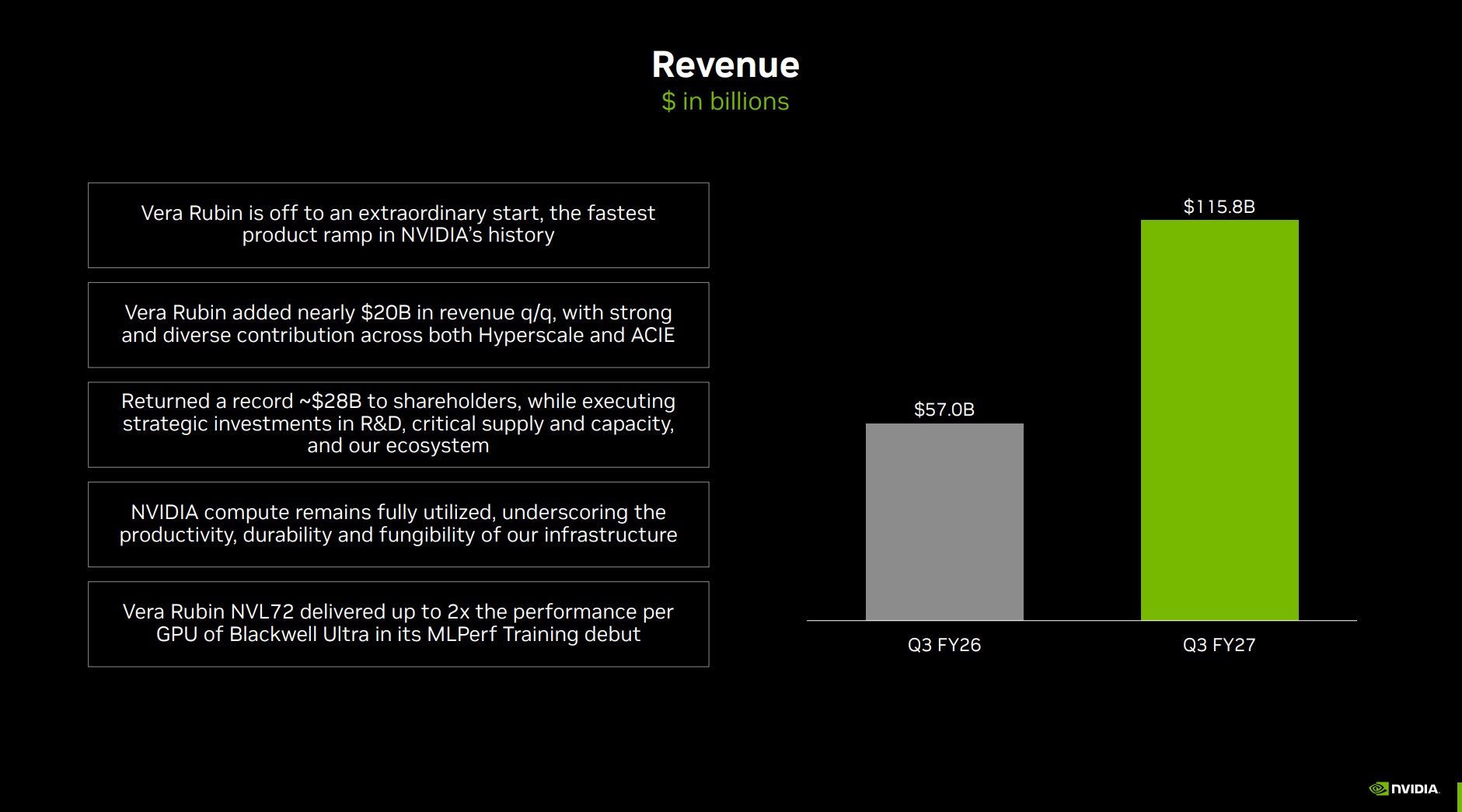
That’s real, and it explains much of Monday’s jump. Still, the business itself barely changed during his absence. Nvidia posted a record $115.8 billion quarter while he was gone. What didn’t change, then, is everything below.
Problem 1: Four Investigations Are Still Running
Reinstatement doesn’t close any inquiry. Nvidia or Huang are still being examined by the SEC, the FBI, California’s attorney general, and several congressional committees, along with the board’s own independent investigation.
Here’s the calendar Huang walks back into:
| Date | What’s scheduled |
| Dec. 1 | Huang’s closed-door, recorded interview with three House committees on foreign affairs, intelligence, and China |
| Dec. 2 | Nvidia general counsel Tim Teter’s interview with the same committees |
| Dec. 3 | Public Senate Banking Committee hearing requested by its chairman, Tim Scott |
| Dec. 8–9 | Federal Reserve meeting, with a rate decision on Dec. 9 |
| Dec. 10 | Senate Banking hearing requested with Commerce Secretary Howard Lutnick |
These sessions were scheduled when Huang was a former CEO. Now he’ll answer questions as the sitting CEO, so anything he says carries more weight for the company and its stock. A transcribed interview is private, and the public sees nothing unless the committees release a transcript, but a Senate hearing would be open.
Problem 2: China and the New Export Rule
Huang helped broker the deal that let Nvidia sell its older H200 AI chips to approved Chinese buyers. During his absence, though, Nvidia said it would stop those sales, and its forecast for this quarter assumes no data center chip revenue from China.
The bigger issue is a Commerce Department rule issued on November 16. It requires licenses to ship advanced AI chips to Indonesia, Malaysia, Singapore, Thailand and Brazil, in an effort to stop Chinese companies from renting that computing power remotely. Investment bank Jefferies estimated the rules could cut $44 billion to $62 billion from Nvidia’s data center revenue next year. By our math, that’s about 10% to 14% of a year at the latest quarter’s pace.
A returning CEO can lobby Washington, and Huang has done that successfully before. However, a published rule doesn’t reverse because the boss is back.
Problem 3: Money Is Getting More Expensive
The AI buildout runs on borrowed money as well as cash. When interest rates rise, so does the cost of building data centers, and that can shrink chip orders.
As of Monday, markets priced roughly a 91% to 92% chance that the Federal Reserve raises rates at its December 8–9 meeting, and the 10-year Treasury yield sat near 4.94%. A strategist at Japanese bank Nomura called Monday’s rally a largely mechanical bounce, driven partly by traders closing bets against stocks. He warned that sticky inflation, higher borrowing costs and cooling expectations for corporate AI spending could still push investors toward cash and bonds.
None of that depends on who runs Nvidia.
Problem 4: Somebody Has to Pay for the AI Buildout
Nvidia’s revenue is other companies’ spending. So the real test is whether its customers can keep paying.
That question started the selloff before the scandal did. Chip stocks fell hard after the November 3 midterms, as investors bet that Democrats will slow the AI buildout through state and local data center rules. By last Friday, the S&P 500 had entered a correction, a drop of 10% or more from its peak, with about $8 trillion lost since October 6.
Debt is the newer worry. Anthropic, one of the biggest buyers of AI computing, has about $900 billion in computing commitments over two decades. Investors expect its debt to get a high-yield, or “junk,” rating, although none has been announced. Its shares, which listed at $83, traded below $88 on Monday after falling 9% on Friday. The Anthropic IPO has turned into a live test of how much risk investors will take on AI spenders.
Problem 5: A Board That Changed Its Mind in Six Days
On November 17, Nvidia’s board chair said the board didn’t intend to reinstate Huang. Six days later, it did.
There’s a fair case for the reversal: the board says it did its homework, and it added a compliance chief who answers to directors. However, critics see the opposite. One analyst said the board is effectively signaling it “can tolerate this poor judgment.” Add the White House’s public role, and some long-term investors will ask how independent the board really is.
Governance issues rarely move a stock day to day, but they matter when something goes wrong. The compliance officer hire and the board investigation’s final findings are the two signals to watch.
The Scorecard
| Issue | Before Huang resigned | After Huang returned | Changed? |
| Who runs Nvidia | Huang | Huang | Restored |
| Federal and congressional probes | Starting | Ongoing, with Dec. 1–3 dates | No |
| China and Southeast Asia export rules | Tightening | New licensing rule in force | No |
| Interest rates | Hike expected | Hike expected Dec. 9 | No |
| AI customers’ spending and debt | Under question | Under question | No |
| Board oversight | No chair until Nov. 12 | Chair and compliance officer | Stronger on paper |
Prices are as of the market close on November 23, 2026. This article is for information only and is not financial advice.
FAQs
What’s the difference between a transcribed interview and a hearing?
A transcribed interview is a private session in which committee staff and lawmakers question a witness while a stenographer records every word. The public only sees it if the committee releases the transcript. A hearing is held in public, often on camera, and witnesses usually give an opening statement.
Why did the whole stock market rise with Nvidia?
Nvidia is one of the largest companies in the S&P 500 and Nasdaq, so a big move in its shares shifts the indexes directly. It also acts as a mood gauge for AI stocks, which make up a large share of the market’s value. When Nvidia rallies hard, other chip and AI names often follow.
What is a stock market correction?
A correction is a drop of at least 10% from a recent high. It’s more severe than a dip but less severe than a bear market, which is a fall of 20% or more. Corrections happen fairly often and don’t always lead to longer downturns.
Did the AI selloff affect crypto?
Yes. Many traders treat Bitcoin and AI stocks as similar high-risk bets, so they often fall together. During last week’s slide, crypto traders lost $2.4 billion in leveraged bets in a single day. Bitcoin recovered above $63,000 on Monday.
Does Nvidia invest in its own customers?
Yes. Nvidia has invested in AI labs and cloud providers that also buy its chips, which critics say can inflate demand. Here’s how Nvidia finances parts of the AI boom and the risks that creates.
The post Jensen Huang Is Back, and Nvidia Won $952 Billion in a Day. Here Are 5 Problems His Return Doesn’t Touch appeared first on Memeburn.