
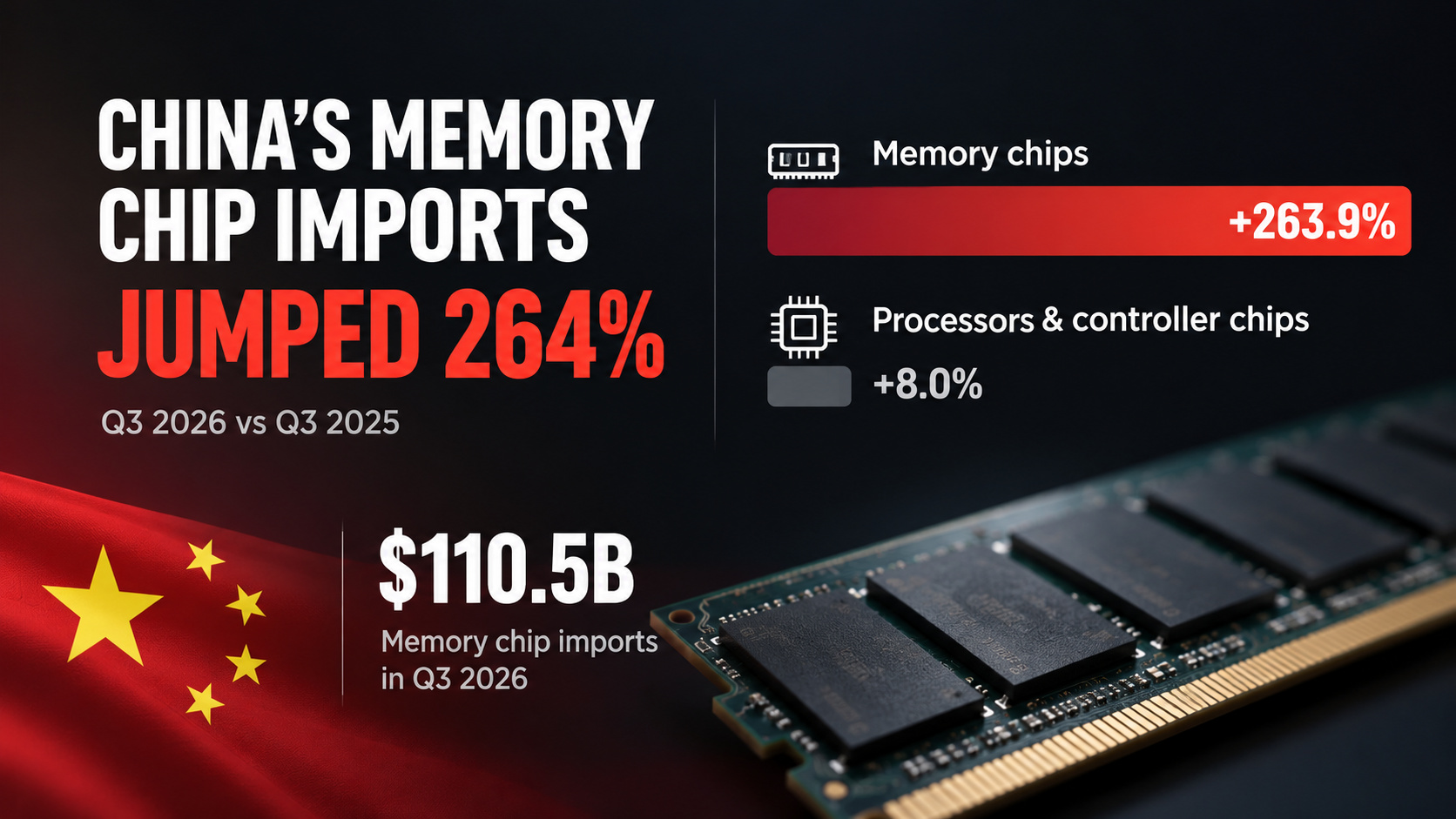
China imported about $110 billion worth of memory chips in the third quarter of 2026, up from $30 billion in the same quarter last year, according to figures SemiAnalysis shared on X. Just a week earlier, NVIDIA had disclosed that its total supply commitments had climbed to $390 billion, with most of the increase coming from multi-year deals to buy memory.
Put side by side, the two numbers show how the race to build AI infrastructure is feeding into the cost of making electronics, and even into the trade balance of the world’s second-largest economy. So how big is China’s memory bill really, how much of it can be traced back to AI demand, and what does that mean for the price of your next phone or laptop?
Below, I’ll walk through the import data, NVIDIA’s supply commitments, the knock-on effect on consumer devices and what the numbers mean for China’s GDP.
China’s Memory Chip Imports Jumped Nearly 264% in a Year

Binance Referral Code
$100 Sign-Up Bonus
20% Lifetime Discount on Trading Fees
Code Valid: November 2026
Claim Reward
Customs data compiled by ChinaData shows China imported more than $34.7 billion of memory chips in July, $37.2 billion in August and $38.4 billion in September 2026.
What stands out is how much faster the value of memory imports grew compared with imports of processors and controller chips.
| Imported chip type | Q3 2025 | Q3 2026 | Growth |
| Memory chips | $30.36 billion | $110.48 billion | 263.9% |
| Processors and controller chips | $55.30 billion | $59.75 billion | 8.0% |
Within a single year, China’s memory chip import bill grew by about $80 billion, while the processor and controller category added only about $4.5 billion. That gap doesn’t mean China is importing 3.6 times as many memory chips as it did last year, though, because the value of imports also depends on selling prices, memory capacity, product mix and the volume actually bought.
China also exported about $93 billion worth of memory chips in the third quarter, which pushed the trade deficit in this product group to $17 billion, compared with $13 billion in the previous quarter and $5 billion a year earlier.
NVIDIA Is Committing Hundreds of Billions of Dollars to Lock In Supply
In its CFO commentary published on November 17, NVIDIA said its total supply and capacity commitments rose from $279 billion to $390 billion, and that most of the increase came from multi-year agreements to secure memory supply.
That extra $111 billion is close to the entire value of the memory chips China imported over three months. NVIDIA’s commitments cover many kinds of components as well as future manufacturing capacity, however, so you can’t read the figure as money the company spent on memory chips during the quarter.
The scale of NVIDIA’s memory needs becomes clearer once you look at its hardware. According to NVIDIA’s official specifications, each Rubin GPU, the graphics processor that does most of the computing in an AI data center, comes with 288GB of HBM4. HBM stands for High Bandwidth Memory, a type of memory built to feed data to the GPU much faster while it trains and runs AI models. Since an HGX Rubin system uses eight of these GPUs, it carries about 2.3TB of HBM in total.
When tech companies deploy thousands of these systems in their data centers, memory demand grows with both the number of GPUs and the amount of memory on each one. That gives memory makers a strong reason to move more of their production capacity toward products that serve AI, a mechanism I broke down in our piece on the 2026 AI memory chip supercycle.
The AI Race Is Raising the Cost of Building Your Next Phone
Smartphones don’t use HBM4 the way Rubin GPUs do, but the DRAM inside your phone and the HBM in AI systems still compete for part of the same semiconductor manufacturing capacity. DRAM, short for dynamic random-access memory, is the working memory a device uses to keep apps and data ready while it runs. So when manufacturers prioritize high-value memory products for data centers, the supply left for consumer electronics can shrink.
In its July report, TrendForce forecast that contract prices for conventional DRAM would rise another 13% to 18% in Q3 2026, while prices for NAND Flash, the type of memory that stores data on phones and solid-state drives (SSDs), would climb 10% to 15%. TrendForce also noted that the shift of production capacity toward server applications is limiting the DRAM supply available for PCs.
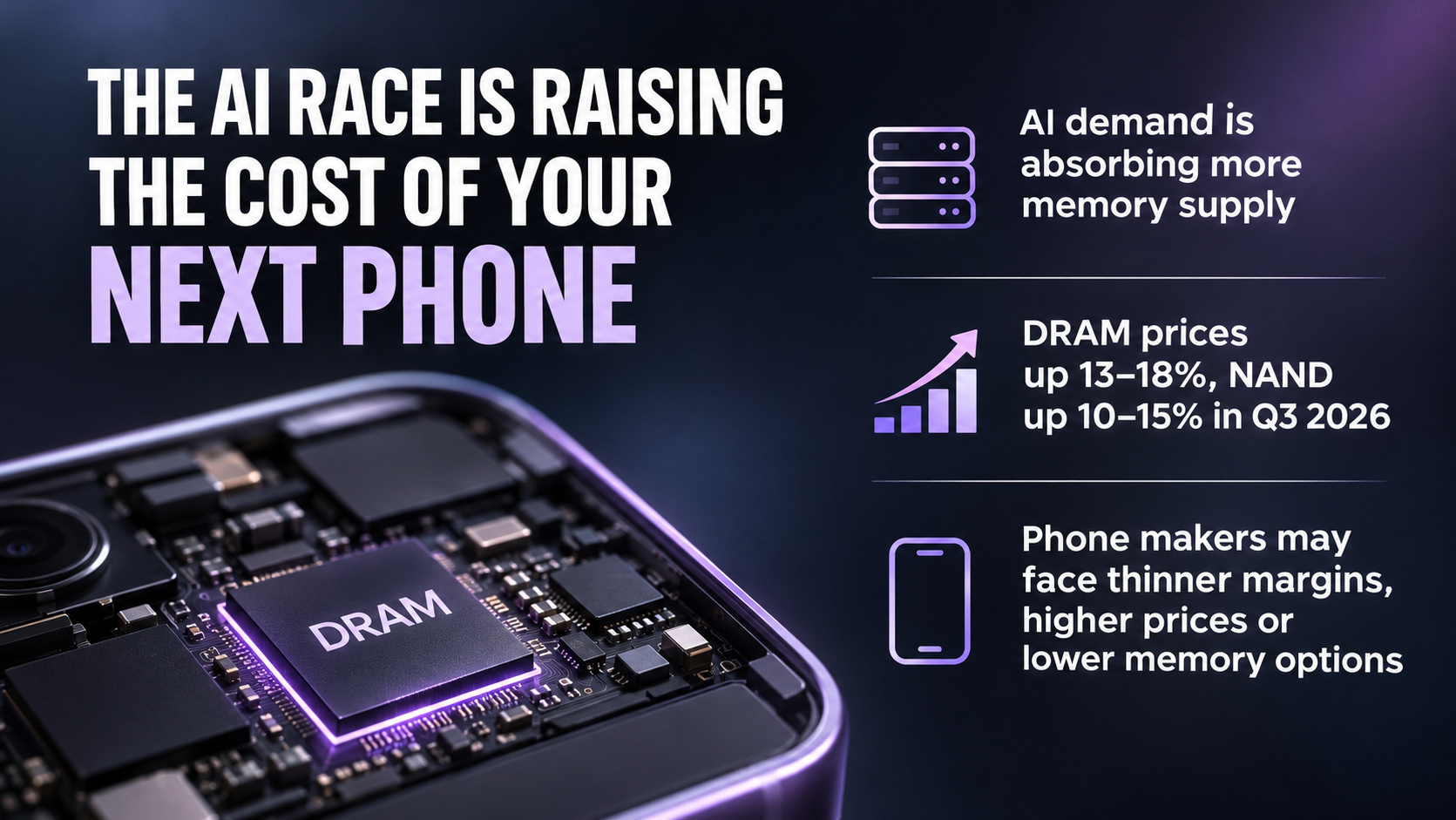
For phone and laptop makers in China, rising component costs leave them with a few options: they can accept thinner margins, raise retail prices or adjust the memory configurations of new products to keep costs under control. If you’re thinking about buying a new phone or upgrading your computer, this is one of the ways the AI investment boom can show up directly in what you pay. Samsung’s decision to reallocate its memory production capacity this year reflects the same shift.
How Much Did Memory Chips Weigh on China’s GDP Growth?
SemiAnalysis estimates that the widening memory chip trade deficit was equivalent to 6.9% of China’s quarter-on-quarter GDP growth in Q3 2026. By its calculation, memory chip imports rose by about 135 billion yuan while exports rose by 105 billion yuan, and the 30 billion yuan difference works out to 6.9% of the estimated 434 billion yuan increase in GDP.
That doesn’t mean China’s GDP fell by 6.9%. It’s a way of sizing the swing in memory chip trade against the extra GDP added during the quarter, rather than an official measure of how much the memory sector contributed to real GDP growth. Memory imports also support the production and export of finished electronics, so you can’t count the whole import bill as an economic loss.
Even so, China’s dependence on foreign suppliers is worth paying attention to, since South Korea accounted for 57.7% of the value of China’s memory chip imports in September 2026, according to ChinaData. That helps explain why the expansion of domestic companies such as ChangXin Memory Technologies (CXMT) matters for China’s economy well beyond the chip industry.
NVIDIA’s Long-Term Contracts Could Stretch Out the Supply Squeeze
What I think is worth watching in this memory crunch is how hard AI companies that can sign multi-year contracts will compete for supply against electronics makers that buy components at whatever the price happens to be in each cycle.
NVIDIA’s supply commitments grew by nearly 40% in a single quarter, and of the $390 billion total, about $295 billion, or close to 76%, is allocated to fiscal years 2028 and 2029. Long-term contracts give memory makers a solid basis for investing in new factories, but until that new capacity comes online, they can also shrink the flexible supply available to other customers.
Data for October 2026 shows China’s memory chip imports fell to about $30.2 billion, 21.4% lower than in September. I think it’s worth watching whether that decline continues over the coming months or simply reflects a short-term adjustment in purchasing and inventory. If memory production capacity grows fast enough, or if AI investment demand weakens, price pressure could ease considerably, even if NVIDIA keeps its commitments at this scale.
FAQs
Why does China import so many memory chips?
China has a huge electronics manufacturing industry that needs memory for phones, computers, servers and many other devices, and its domestic manufacturers still have to import a significant amount of those memory chips from international suppliers.
Does NVIDIA make its own memory chips?
NVIDIA designs GPUs and AI computing systems, but it relies on semiconductor and memory manufacturing partners to supply the components for those systems.
Why is AI demand pushing up RAM prices?
AI systems use large amounts of high-performance memory and server memory, and when suppliers prioritize those products, the production capacity left for conventional DRAM can be limited, which puts upward pressure on RAM prices.
The post China Spent $110 Billion on Memory Chip Imports. Where Does NVIDIA Fit In? appeared first on Memeburn.