
NVIDIA won back nearly $1 trillion in market value in a single trading session on November 23, 2026, after the company announced that Jensen Huang would return as CEO. The news set off a sharp rally across the US stock market, led by companies tied to artificial intelligence (AI) and semiconductors.
What makes this remarkable is that one of the most valuable companies in the world moved the way much smaller, far more speculative assets usually do. So how can a company this big jump 31.5% in a day, how much real money actually went in, and what does the rally say about where investors are putting their capital right now?
I’ll start with the day’s numbers, then look at the gap between market value and cash, how concentrated the market has become, what gold’s October data reveals about chasing returns, and where I think the market’s blind spots could be.
Why Can a Trillion-Dollar Company Rise 31.5% in One Day?

Binance Referral Code
$100 Sign-Up Bonus
20% Lifetime Discount on Trading Fees
Code Valid: November 2026
Claim Reward
NVIDIA’s stock rose from $125.53 to $165.05 on November 23, its biggest one-day gain since May 2003. The rebound also spread to other companies and indexes, according to market data compiled by Reuters.
| Stock or index | Gain |
| NVIDIA | 31.5% |
| CoreWeave | 22.3% |
| Philadelphia Semiconductor Index (SOX) | 14.0% |
| S&P 500 information technology sector | 9.0% |
| Meta | 6.6% |
| Nasdaq Composite | 6.51% |
| Alphabet | 6.3% |
| S&P 500 | 4.73% |
| Amazon | 3.5% |
| Dow Jones Industrial Average | 3.01% |
Trading volume on US exchanges reached 22.37 billion shares that day, nearly 15% above the average of the previous 20 sessions.
What makes the session unusual is the size of the company behind the move. A $100 million company rising 30% in a day is fairly easy to picture, but when the same thing happens to a business worth trillions of dollars, the shift in market expectations can ripple through the portfolios of millions of people.

Less than a week before Jensen’s return was announced, NVIDIA had reported record quarterly revenue of $115.8 billion, up 103% from a year earlier. Yet, as I covered in our look at NVIDIA’s earnings without Jensen Huang, those impressive results didn’t stop the stock from falling further in the sessions that followed. That suggests that in the short term, shifts in investor sentiment, expectations and appetite for risk can move a stock harder than the earnings report that just came out.
NVIDIA Added Nearly $1 Trillion in Value, but How Much Money Actually Went In?
It’s worth being clear that NVIDIA gaining nearly $1 trillion in market value doesn’t mean investors poured $1 trillion in cash into the company. Market capitalization, or market cap, is simply the share price multiplied by the number of shares outstanding, so when buyers and sellers trade at a higher price, that new price is used to value every share the company has, including the ones nobody traded that day.
During sessions with big swings, other activity can amplify the move as well. Short covering, which happens when traders who bet against a stock buy it back to close their positions, can add buying pressure, and so can options trading and funds rebalancing their portfolios. There isn’t enough data yet to say how much each of these contributed to NVIDIA’s rebound. Even so, the size of the move and the jump in volume show how sensitive the market has become to any news that could change short-term profit expectations.
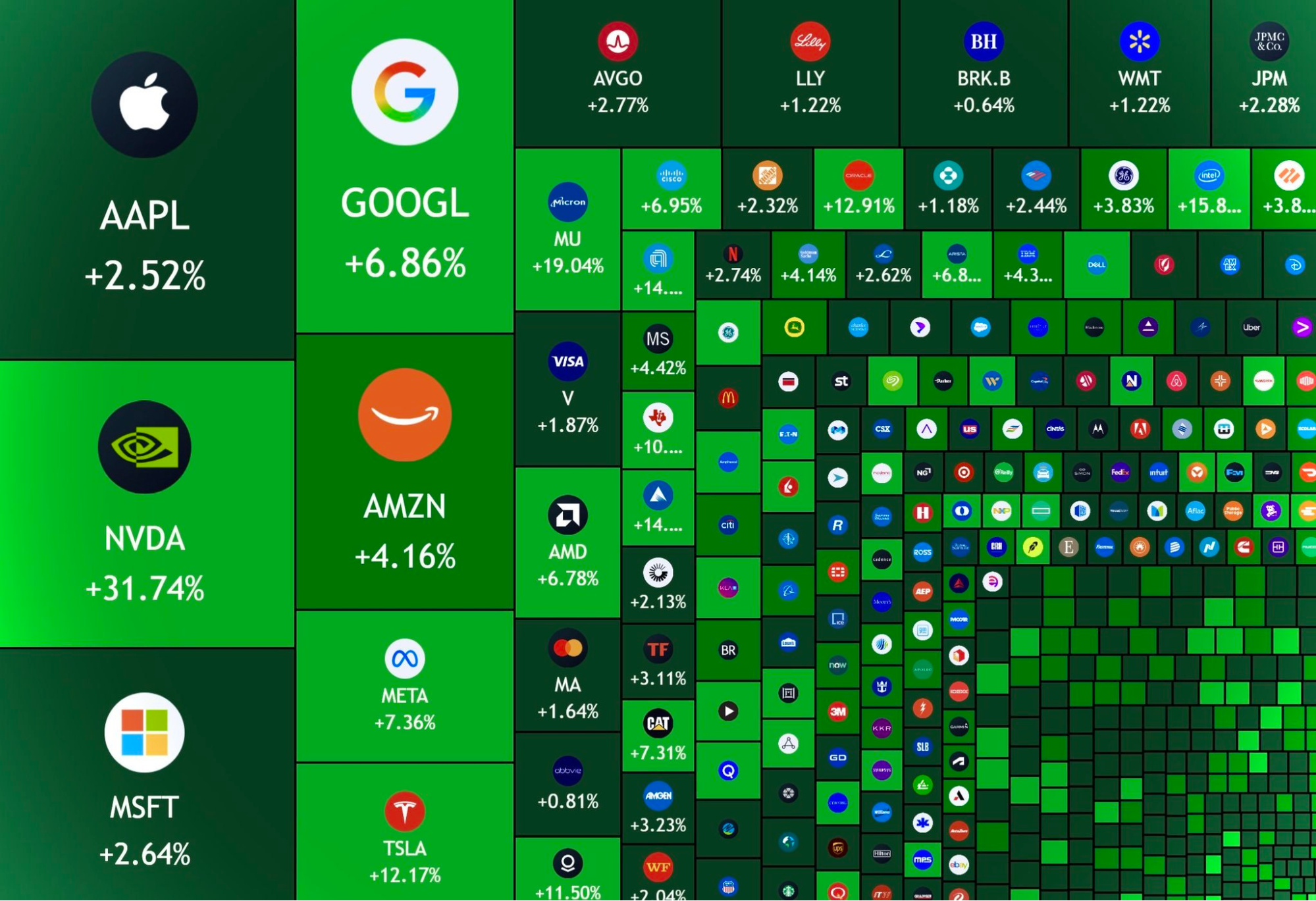
According to NVIDIA’s historical price data, the stock was still about 31% below its October 6 close of $239.24, even after the 31.5% rebound. In other words, an investor who bought NVIDIA in early October is still sitting on a sizable loss, while someone who bought at the end of last week could have made more than 30% in a single session.
Growth Expectations Are Concentrated in a Handful of Companies
According to S&P Dow Jones Indices, the 10 largest companies made up 37.3% of the S&P 500 as of November 20, 2026. That level of concentration means that even if you invest through an index fund that tracks the S&P 500, a significant share of your portfolio’s performance still depends on how a small group of companies moves.
For NVIDIA, the influence goes beyond its own weight in the indexes. Microsoft, Alphabet and Amazon are investing heavily in AI infrastructure, companies like CoreWeave have built their entire business on demand for rented computing capacity, and makers of memory chips, chipmaking equipment and the power supply for data centers all have economic stakes tied to the industry’s growth. So when an event changes expectations for NVIDIA’s growth, investors can end up repricing many other companies in the AI supply chain at the same time. That’s also why I previously looked at Jensen Huang’s role at NVIDIA through the business relationships, product strategy and ecosystem the company has built around him.
Although more than 4,000 stocks on the Nasdaq rose on November 23, semiconductor and tech stocks still far outpaced the broader indexes.
What Gold’s October Data Says About Chasing Returns
When gold prices keep climbing, the market tends to pay more attention to precious metals, in much the same way AI stocks draw interest when they keep delivering big gains. Behavioral finance calls this return chasing, which is the tendency to put money into assets that have just performed well in the hope that the gains will continue.
But market attention and actual capital allocation don’t always move together. According to the World Gold Council, global gold trading volume fell 13% in October 2026, while gold ETFs, the exchange-traded funds that hold physical gold and trade like stocks, still drew in $2.7 billion.
| Gold market indicator, October 2026 | Change |
| Global trading volume | -13% |
| Exchange-traded derivatives volume | -25% |
| Inflows into gold ETFs worldwide | +$2.7 billion |
| Total gold ETF assets under management | -6% |
| Gold held by ETFs | 4,275 tonnes, a new record |
These figures show that short-term trading can cool off even while investors keep accumulating an asset. So the fact that an asset shows up less often in the media, or has stopped posting big rallies, isn’t enough on its own to conclude that long-term money has left it.
Market Concentration Can Leave Valuation Gaps Elsewhere
My read is that while the market is fixated on AI, one of the more interesting places to research is companies whose earnings are improving but whose valuations haven’t caught up with that change.
NVIDIA just posted a 31.5% one-day gain while the S&P 500 rose 4.73%, and the 10 largest companies make up more than a third of the index. A gap that wide shows how much returns can differ depending on how exposed an investor is to that small group of companies.
Say a company’s earnings per share (EPS), the profit it makes for each share, rise 20% while its stock price stays flat over the same period. Its price-to-earnings ratio (P/E), which compares the share price with that profit per share, would then fall by about 16.7%. If the company’s growth outlook and the quality of its cash flow hold up, that new valuation could be worth a closer look.
That said, a company getting little attention doesn’t automatically make its stock cheap, because a low valuation can also reflect weakening competitiveness, financial risk or poor growth prospects.
Over the coming months, what I’ll be watching is whether the market’s gains stay concentrated in AI companies or start spreading to businesses that can turn revenue growth into real profit and cash flow. It’s the same question I raised when analyzing the revenue phase of the AI stock rally.
FAQs
Why did NVIDIA stock jump 31.5% on November 23, 2026?
NVIDIA’s stock rose from $125.53 to $165.05 on November 23, 2026, after the company announced that Jensen Huang would return as CEO, marking its biggest one-day gain since May 2003.
Does a $1 trillion rise in market cap mean $1 trillion was invested?
No. Market cap is the share price multiplied by the number of shares outstanding, so a higher trading price revalues every share the company has, even though far less cash actually changed hands.
How concentrated is the S&P 500 in 2026?
The 10 largest companies made up 37.3% of the S&P 500 as of November 20, 2026, according to S&P Dow Jones Indices.
The post NVIDIA Jumped 31.5% in One Day. What’s Happening to Global Money Flows? appeared first on Memeburn.