
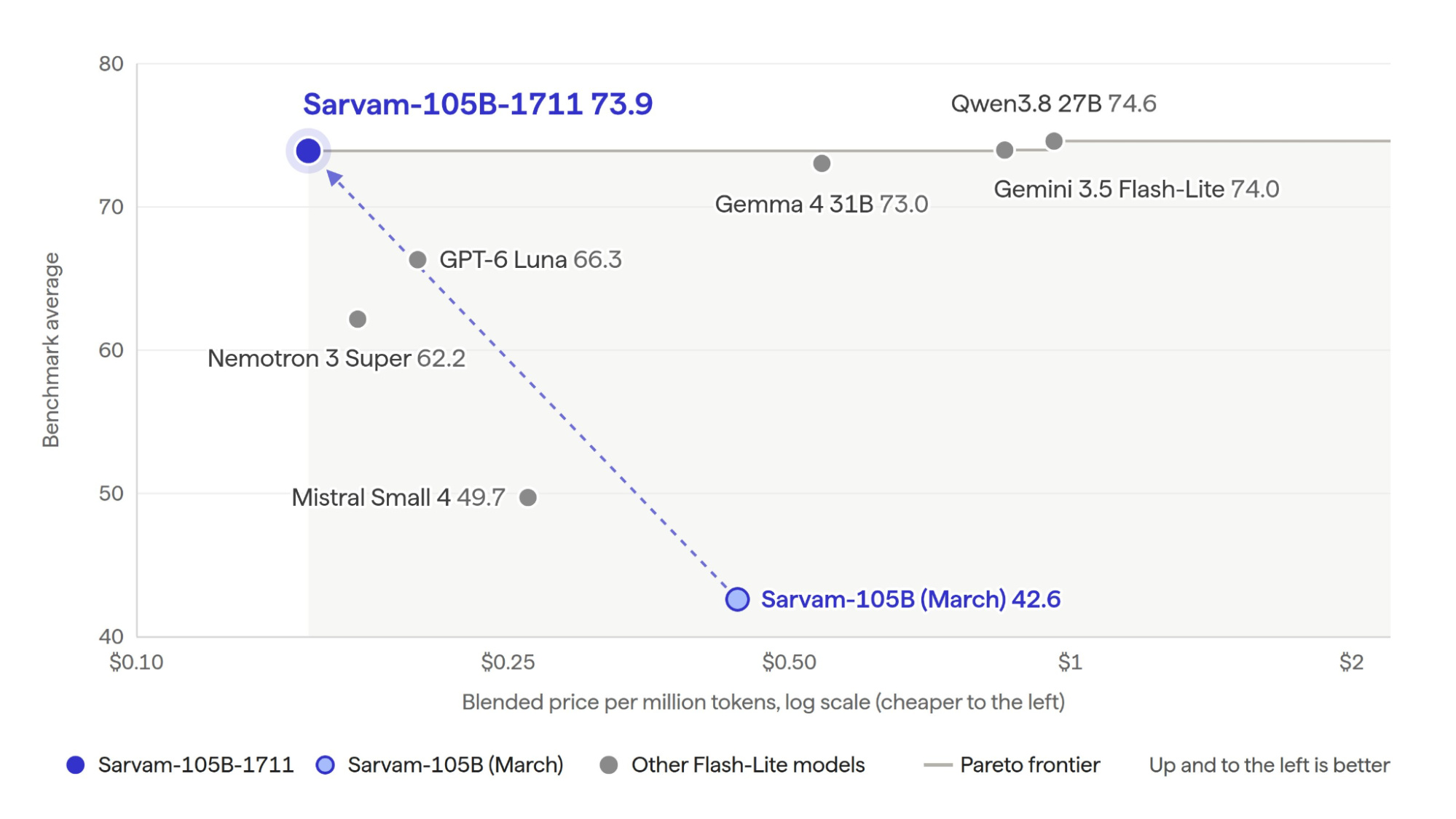
The number Sarvam wants you to remember is 73.9. That’s the average score its new Sarvam-105B-1711 model posts across eight tests for chatbots and AI agents, against 74.0 for Google’s Gemini 3.5 Flash-Lite, while costing about $0.15 per million tokens instead of $0.85. On paper, that’s Gemini-level quality for under a fifth of the price. But “Gemini” covers a whole family of models, and a blended price depends on assumptions, so I went through Sarvam’s own release page to check which Gemini it matched, whether the price gap holds up, and who should actually care. You guys can use our BINANCE REFCODE FOR 40% DISCOUNTED ON TRADING FEE.
Sarvam Ships a New 105B Checkpoint for Agents
Sarvam, a Bengaluru-based AI startup, released Sarvam-105B-1711 on November 22 as an upgraded checkpoint of the 105-billion-parameter model it first showed in February. A checkpoint is a saved version of a model’s trained weights, so this is the same model family trained further, not a new architecture. It’s a mixture-of-experts model, meaning only a slice of the network works on each token (about 10.3 billion of its 105 billion parameters, according to Unite.AI), which is a big part of why it’s cheap to run.
The weights are open, according to Sarvam’s release post, in a full BF16 version (198GB) and a compressed NVFP4 version (65GB) that fits on a single 96GB workstation GPU. Sarvam pitches it as a “Flash-Lite” class model for high-volume jobs such as customer support, voice agents and tool calling, with context stretched to 160,000 tokens.
The release also lands a week into a fight over Sarvam’s Token Factory, the inference service it launched on November 16. Critics have questioned why a company tied to India’s sovereign AI push is selling access to Chinese models from DeepSeek, Moonshot AI, Z.ai and Alibaba, and co-founder Pratyush Kumar has said the service runs on GPUs Sarvam bought privately.
Which Gemini Did Sarvam Actually Match?
Sarvam’s comparison is with Gemini 3.5 Flash-Lite, which sits in the lowest of Google’s three Gemini tiers, below Flash and Pro. That’s a fair fight, since both are built for volume, but it’s narrower than “Gemini-level” suggests.
When I lined up the eight scores in Sarvam’s table, the tie looked even less tidy. Using the NVFP4 version that Sarvam actually serves, Gemini 3.5 Flash-Lite scores higher on five of the eight tests: MultiChallenge, Advanced-IF, Arena-Hard v2, BFCL v4 (function calling) and Sarvam’s own Indic language suite. Sarvam wins three, and its 8.3-point lead on IFBench, a test of following precise instructions, does most of the work in pulling the average level.
Sarvam is upfront about other gaps too, saying Gemini leads on browsing and some work-style tasks and that all scores come from its own evaluation setup. There’s one more wrinkle, which Unite.AI flagged: the Indic suite is Sarvam’s internal test, and it uses Google’s Gemini 3.1 Pro as the judge.
Does the Price Gap Hold Up Outside Sarvam’s Math?
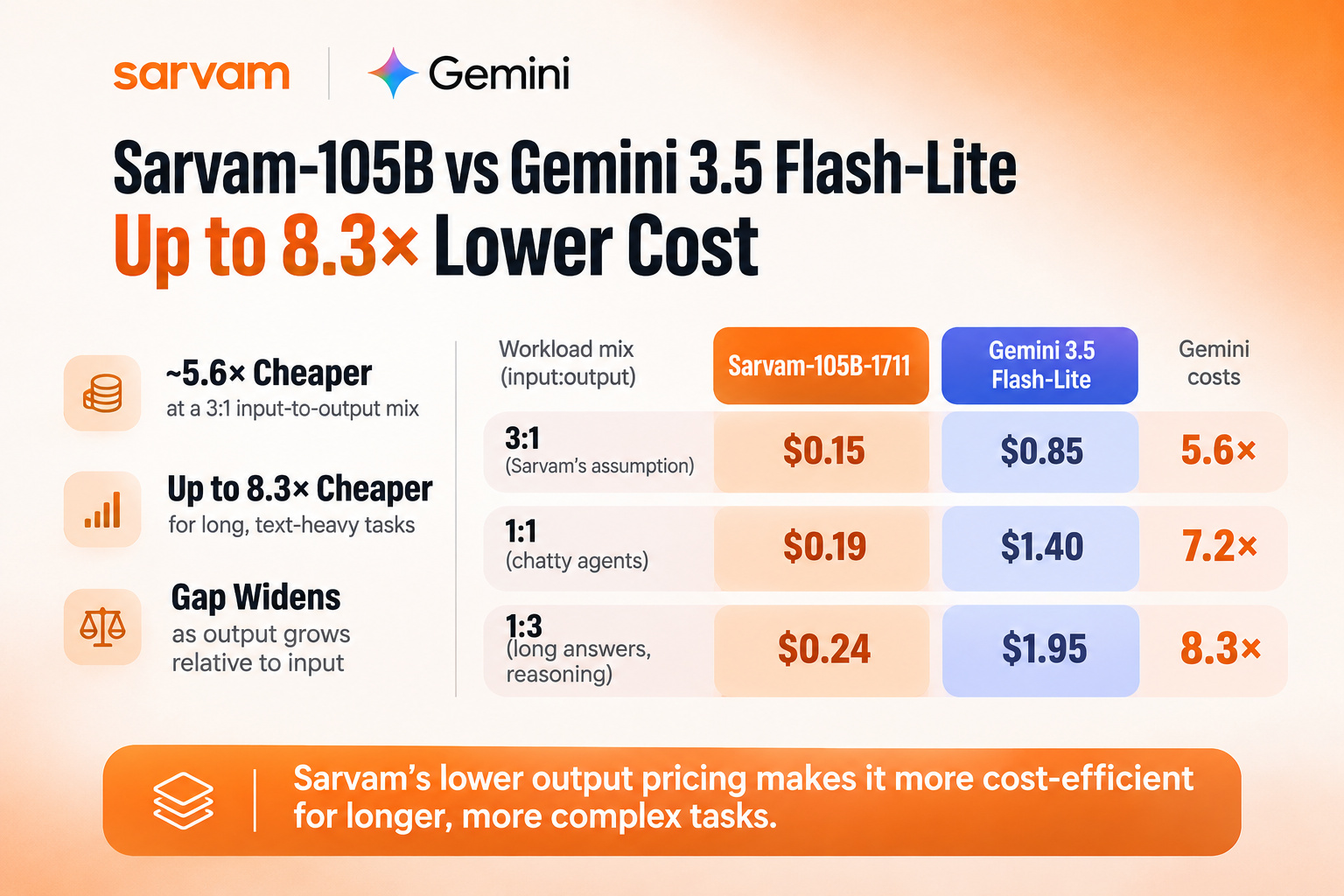
A “blended” price mixes input and output costs into one number. Sarvam assumes three input tokens for every output token, the same convention Artificial Analysis uses, and charges ₹10 per million input tokens and ₹25 per million output tokens on Token Factory. Google lists Gemini 3.5 Flash-Lite at $0.30 input and $2.50 output on its pricing page.
The surprise is that Sarvam’s math is conservative. Because Google charges 8.3 times more for output than input while Sarvam charges 2.5 times more, the gap widens as a job produces more text.
| Workload mix (input:output) | Sarvam-105B-1711 | Gemini 3.5 Flash-Lite | Gemini costs |
| 3:1 (Sarvam’s assumption) | $0.15 | $0.85 | 5.6x more |
| 1:1 (chatty agents) | $0.19 | $1.40 | 7.2x more |
| 1:3 (long answers, reasoning) | $0.24 | $1.95 | 8.3x more |
The Price Lead Is Real, but the Quality Claim Is Narrow
I think Sarvam-105B-1711 is worth a pilot for one kind of buyer: a team running high-volume support, voice or tool-calling agents, especially in Indian languages, where Sarvam’s per-token cost could be a fifth or less of Google’s. The price lead is wide enough to survive a lot. Even if Sarvam doubled its rates when the introductory pricing it lists runs out at the end of 2026, Gemini 3.5 Flash-Lite would still cost about 2.8 times more at Sarvam’s 3:1 mix.
The quality claim is where I’d slow down, since Gemini wins most of the individual tests, handles images and audio, and offers a 1 million token context window against Sarvam’s 160,000. If your work involves documents, screenshots or web browsing, the cheaper model may end up costing more in retries. My view would change if an independent lab reproduced Sarvam’s numbers, which matters because India’s open-weight push now competes directly with China’s free open-weight strategy and the flood of models we tracked in every major AI model that shipped in six weeks. The Token Factory row also touches a fear raised in Anthropic’s distillation battle: who controls the models a country ends up depending on.
FAQs
What is Sarvam-105B-1711?
Sarvam-105B-1711 is an upgraded open-weight checkpoint of Sarvam’s 105-billion-parameter mixture-of-experts model, released on November 22, 2026. It targets customer support, voice agents, tool calling and Indian languages.
Is Sarvam-105B-1711 as good as Gemini?
Sarvam reports an average of 73.9 across eight agent benchmarks, against 74.0 for Gemini 3.5 Flash-Lite. Gemini scores higher on five of the eight individual tests, and all results come from Sarvam’s own testing.
How much does Sarvam-105B-1711 cost?
Sarvam’s Token Factory charges ₹10 per million input tokens and ₹25 per million output tokens, about $0.15 blended at a 3:1 input-to-output mix. The weights can also be downloaded and run on your own hardware.
The post Sarvam’s 105B AI Model Claims Gemini-Level Results at a Fraction of the Cost appeared first on Memeburn.